

Your product might be exceptional. Your service might be flawless. But in 2025’s digital-first marketplace, that’s no longer enough.
Here’s the uncomfortable truth: consumers make split-second judgments about your business before they ever experience what you offer. At scroll speed, your brand identity is doing the talking, and if it’s not saying the right things, your ideal customers are already moving on to your competitor.
This guide breaks down exactly what brand identity is, why it’s become non-negotiable for businesses of all sizes, and how to build one that actually drives results.
Table of Contents
What Is Brand Identity? (Simple Definition)
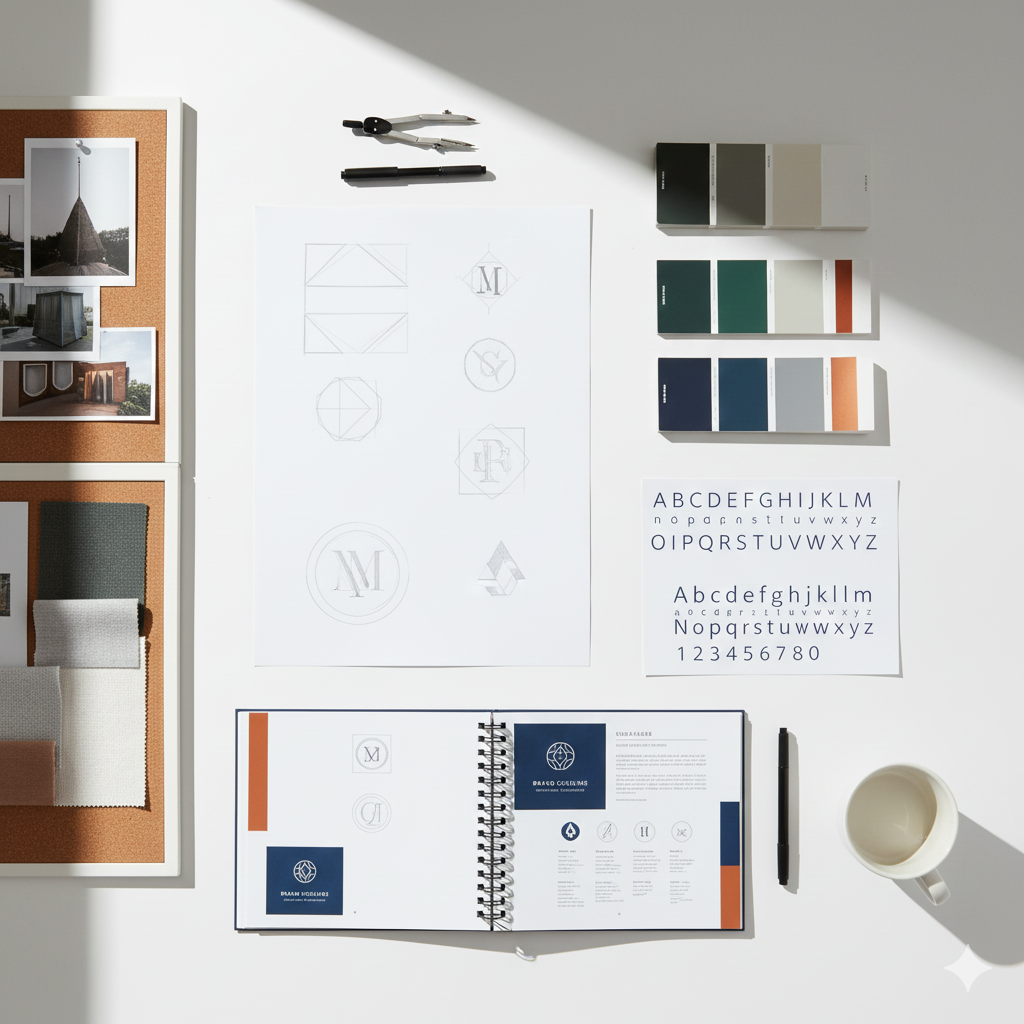
Brand identity is the complete visual and verbal system that represents your business to the world. It’s the deliberate collection of elements—your logo, colors, typography, imagery, voice, and messaging—that work together to create a consistent, recognizable presence across every customer touchpoint.
Think of it as your business’s visual DNA. Just as your DNA determines your physical characteristics, your brand identity determines how your business looks, sounds, and feels to customers.
But here’s where most business owners get confused.
Brand Identity vs. Branding vs. Brand Image — What’s the Difference?
These terms get thrown around interchangeably, but they mean very different things:
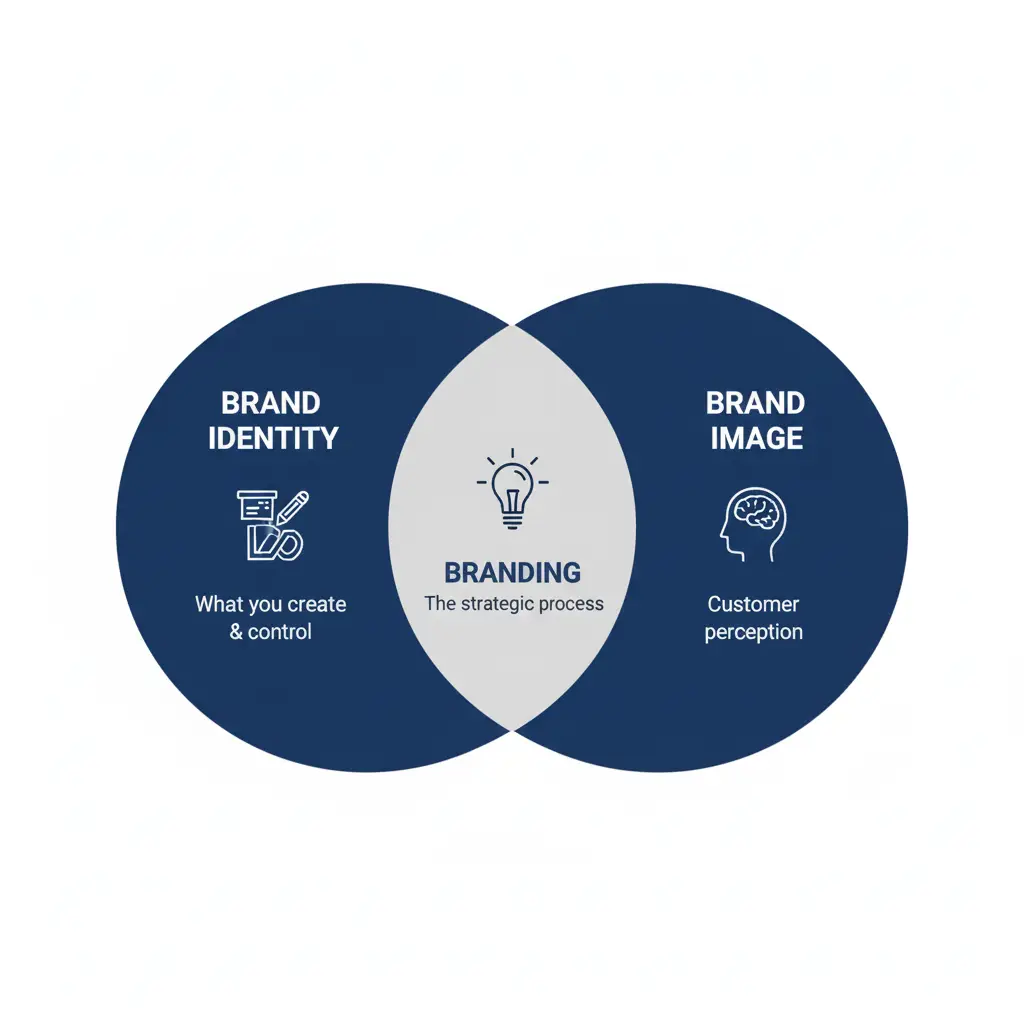
Brand Identity is what you create and control. It’s the tangible expression of your brand—the logo files, color codes, font choices, and voice guidelines that your team uses consistently.
Branding is the strategic process of building and managing your brand over time. It includes your positioning, messaging strategy, and how you communicate your value proposition. Brand identity is one output of this larger branding process.
Brand Image is what exists in your customers’ minds. It’s their perception of your business based on every interaction they’ve had with you. You can influence brand image through strong brand identity, but you can’t directly control it.
According to research from Lucidpress, consistent brand presentation increases revenue by an average of 23%. That consistency starts with a solid brand identity system.
Why Most Business Owners Get This Wrong
The most common mistake? Thinking brand identity is just a logo.
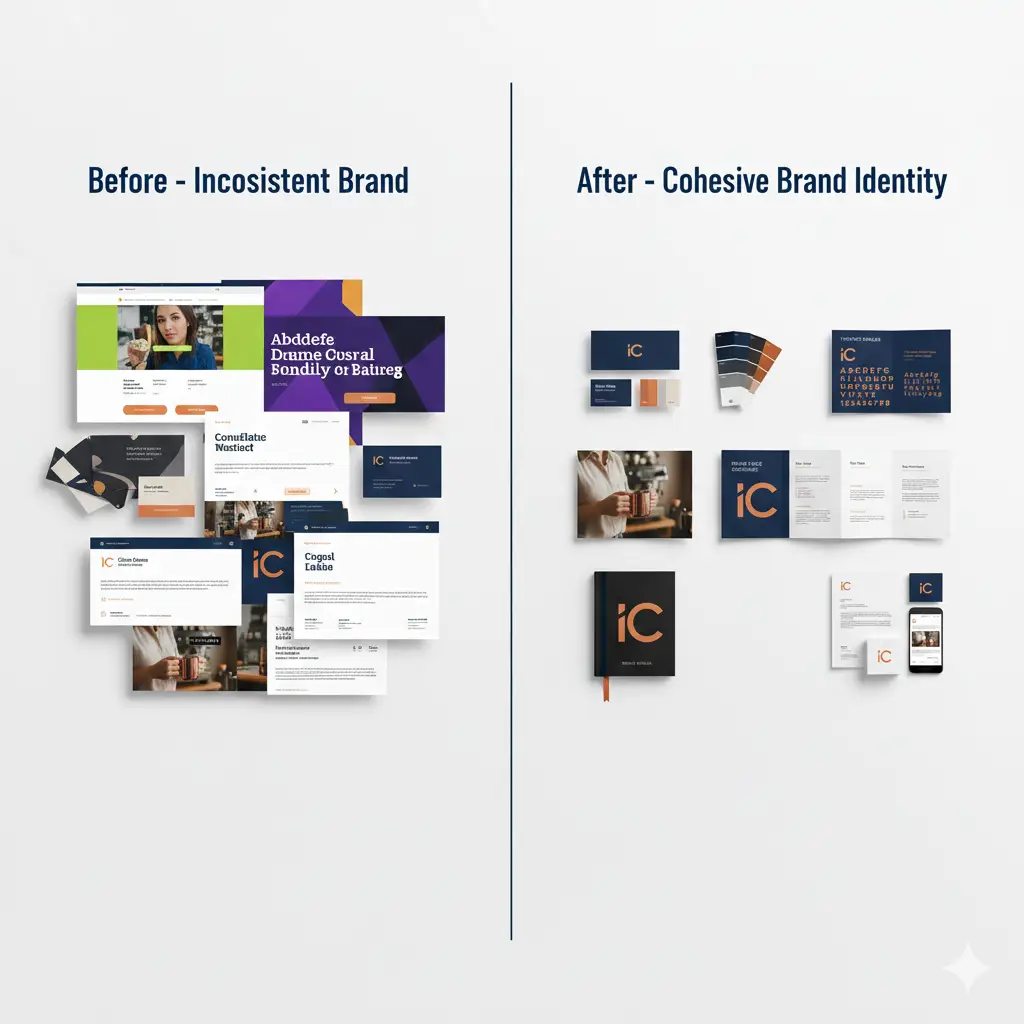
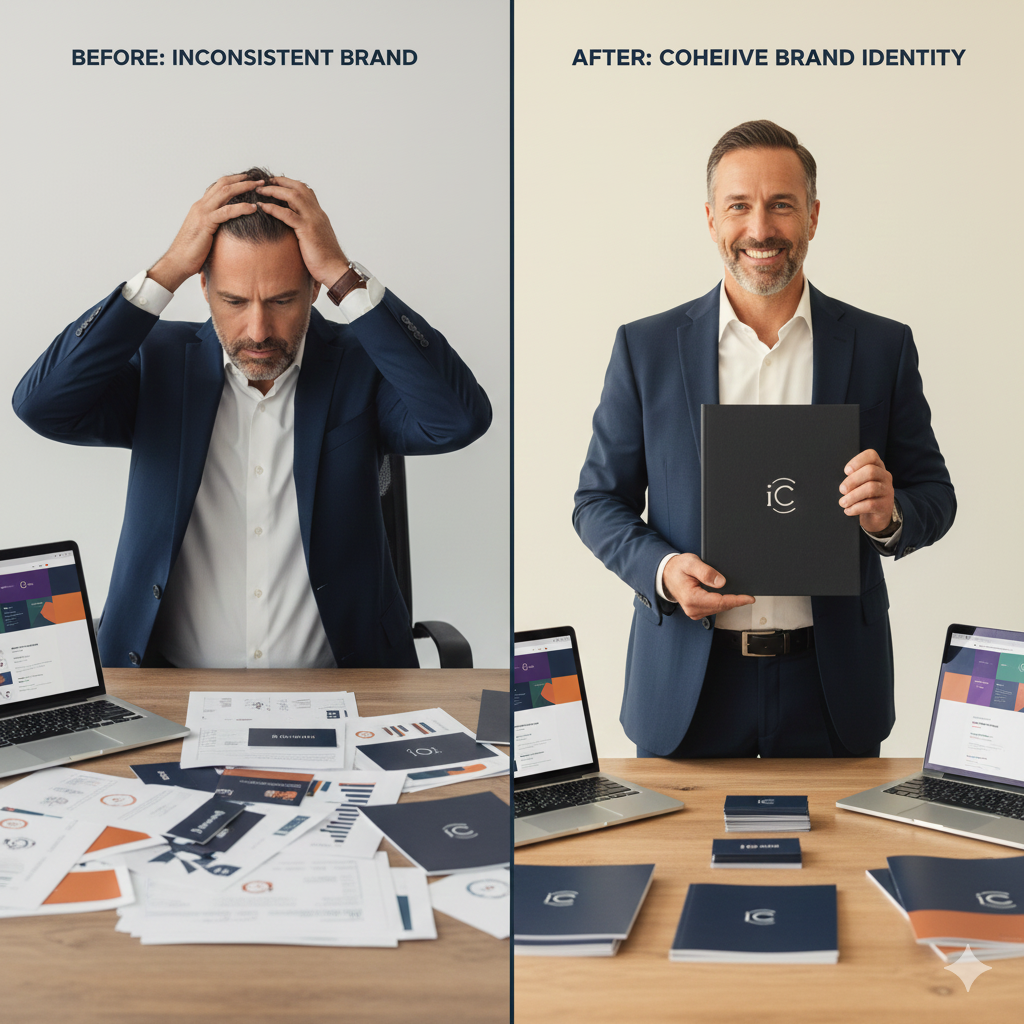
We see it constantly: a business invests in a logo design, slaps it on their website and business cards, and assumes they’re done. Six months later, their Instagram looks completely different from their website. Their email signatures use random fonts. Their presentations feel like they’re from a different company entirely.
That’s not brand identity. That’s visual chaos.
The second mistake is believing “my product should speak for itself.” In 2020, that might have been possible. In 2025, when consumers are bombarded with 5,000+ brand messages per day and AI has commoditized product creation, differentiation happens at the identity level first.
Your brand identity is what gets someone to stop scrolling long enough to discover your product in the first place.
The 7 Core Elements of Brand Identity
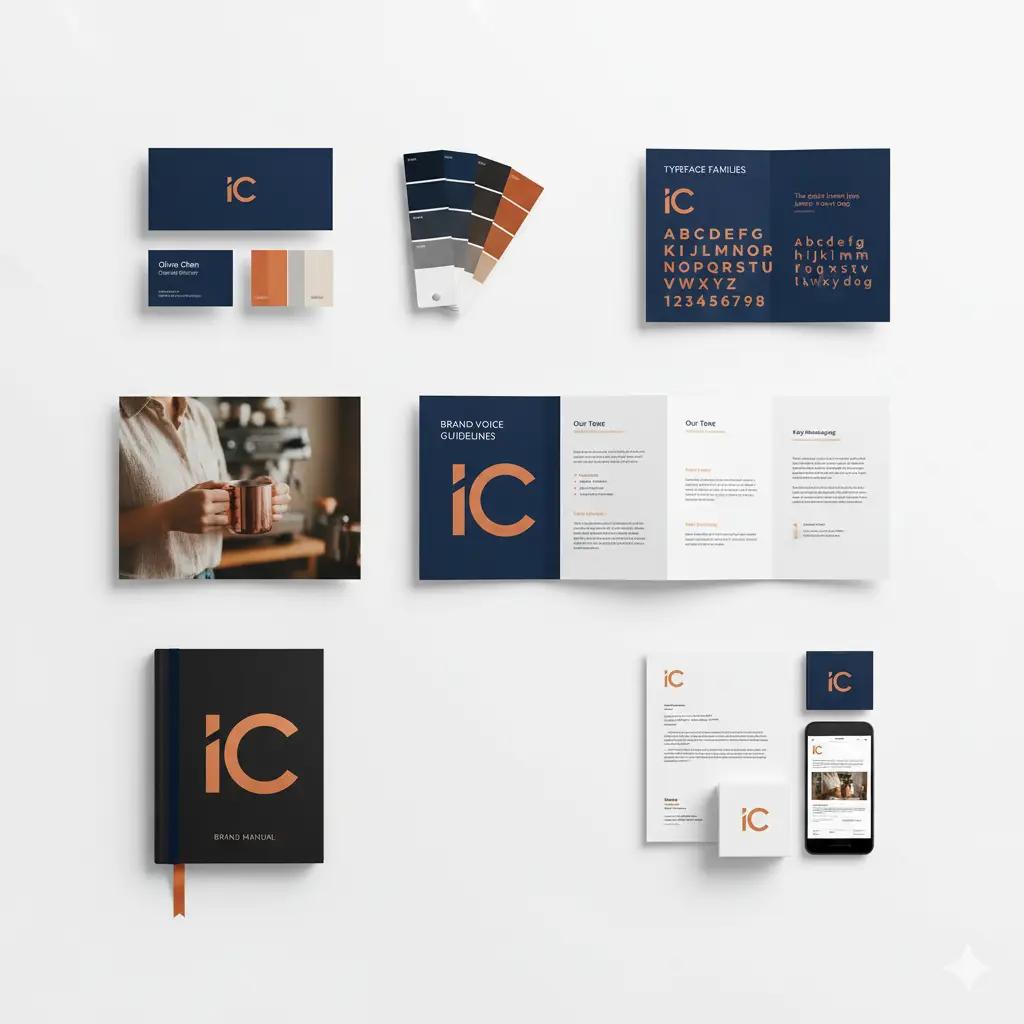
A complete brand identity system includes seven interconnected elements. Skip even one, and you’ll struggle with inconsistency.
1. Logo and Logo Variations
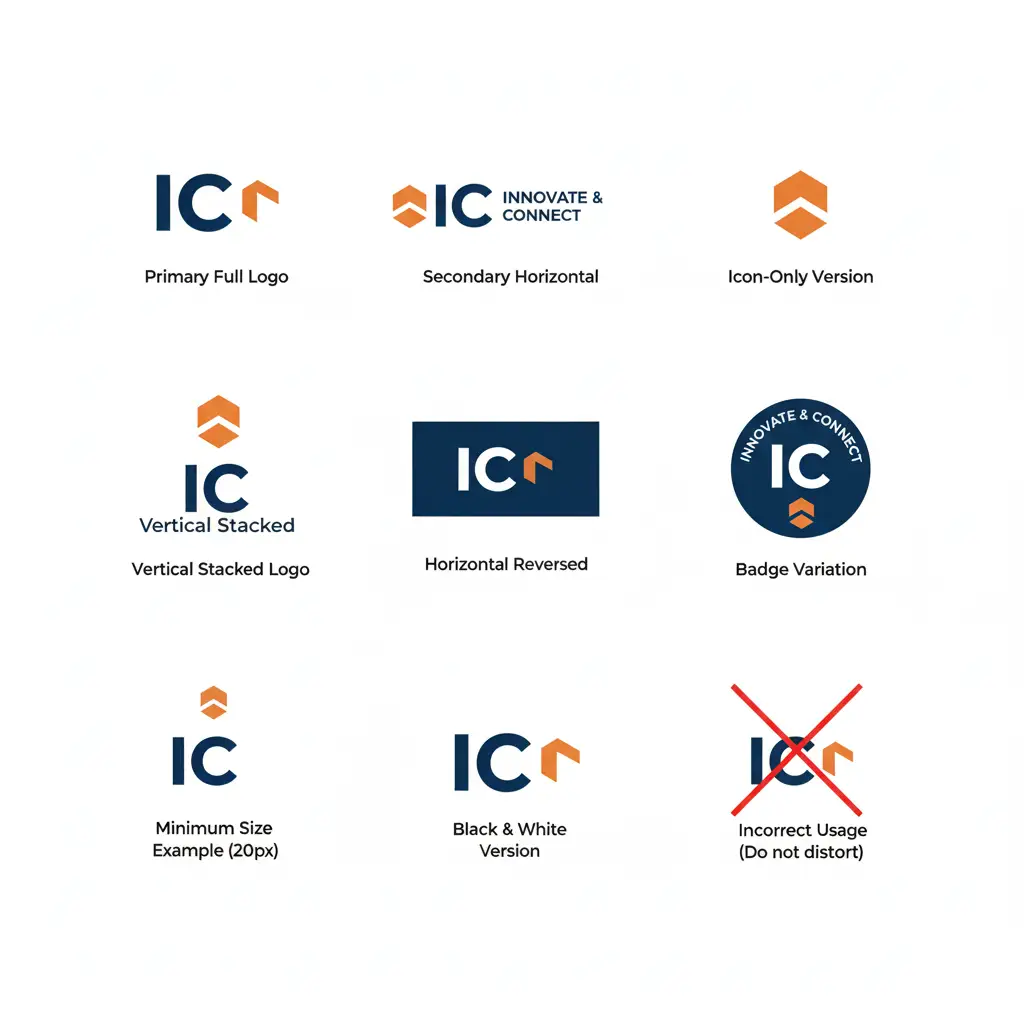
Your logo is the cornerstone, but you need more than one version. A professional brand identity includes:
- Primary logo — Your main mark used in ideal conditions
- Secondary logo — Alternative layout for different applications
- Icon/symbol — Simplified version for profile pictures and app icons
- Horizontal and vertical versions — Flexibility for various layouts
- Light and dark versions — Legibility on different backgrounds
Each variation should feel cohesive while providing the flexibility you need across digital and print applications. Learn more about creating effective logo variations in our guide on the logo design process.
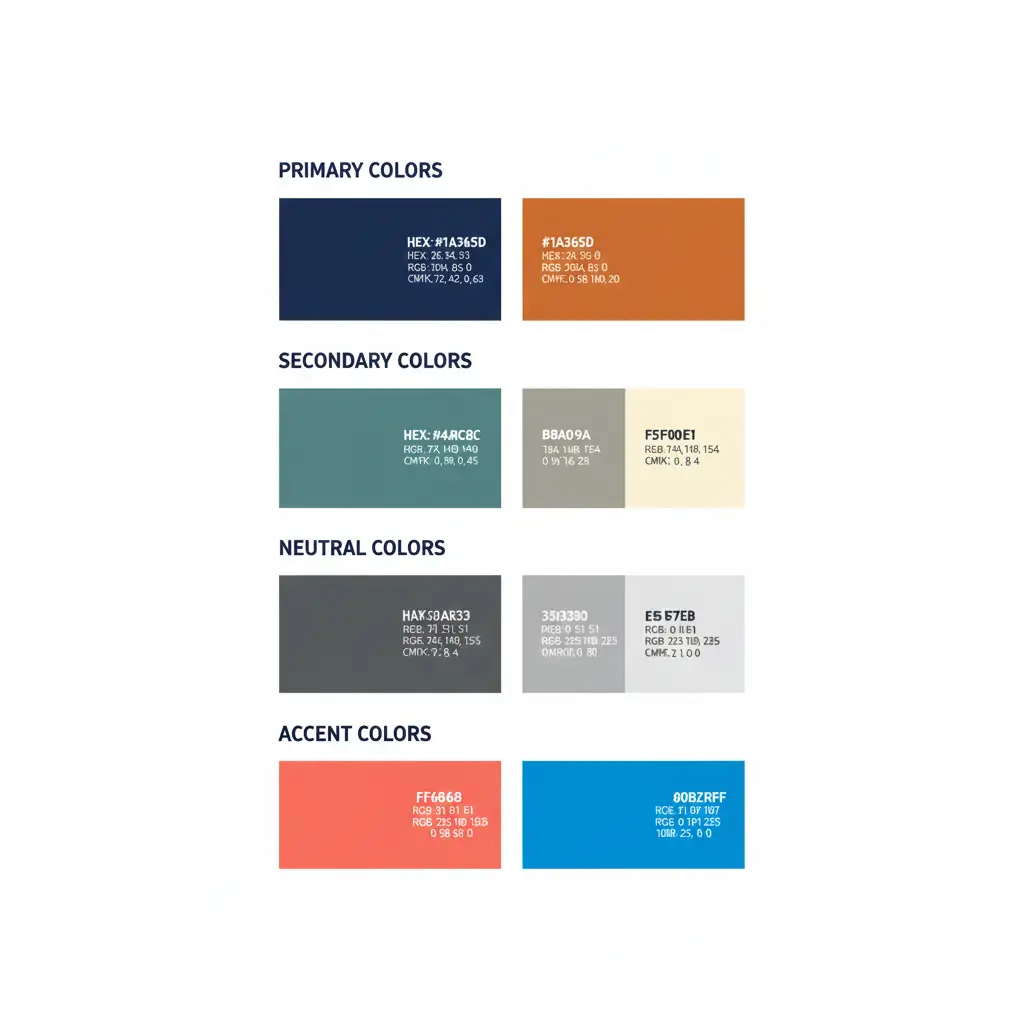
2. Color Palette
Your color palette does heavy psychological lifting. Colors trigger emotional responses and help customers categorize your business instantly.
A strategic color system includes:
- Primary colors (1-2) — Your signature shades that appear most frequently
- Secondary colors (2-3) — Supporting hues that add depth and flexibility
- Neutral colors (2-3) — Backgrounds, text, and balance
- Accent colors (1-2) — Used sparingly for calls-to-action and emphasis
Professional brand identities specify exact color values for every medium: HEX codes for digital, CMYK for print, Pantone for branded materials. Tools like Adobe Color can help you explore color harmonies and accessibility contrast ratios.
3. Typography System
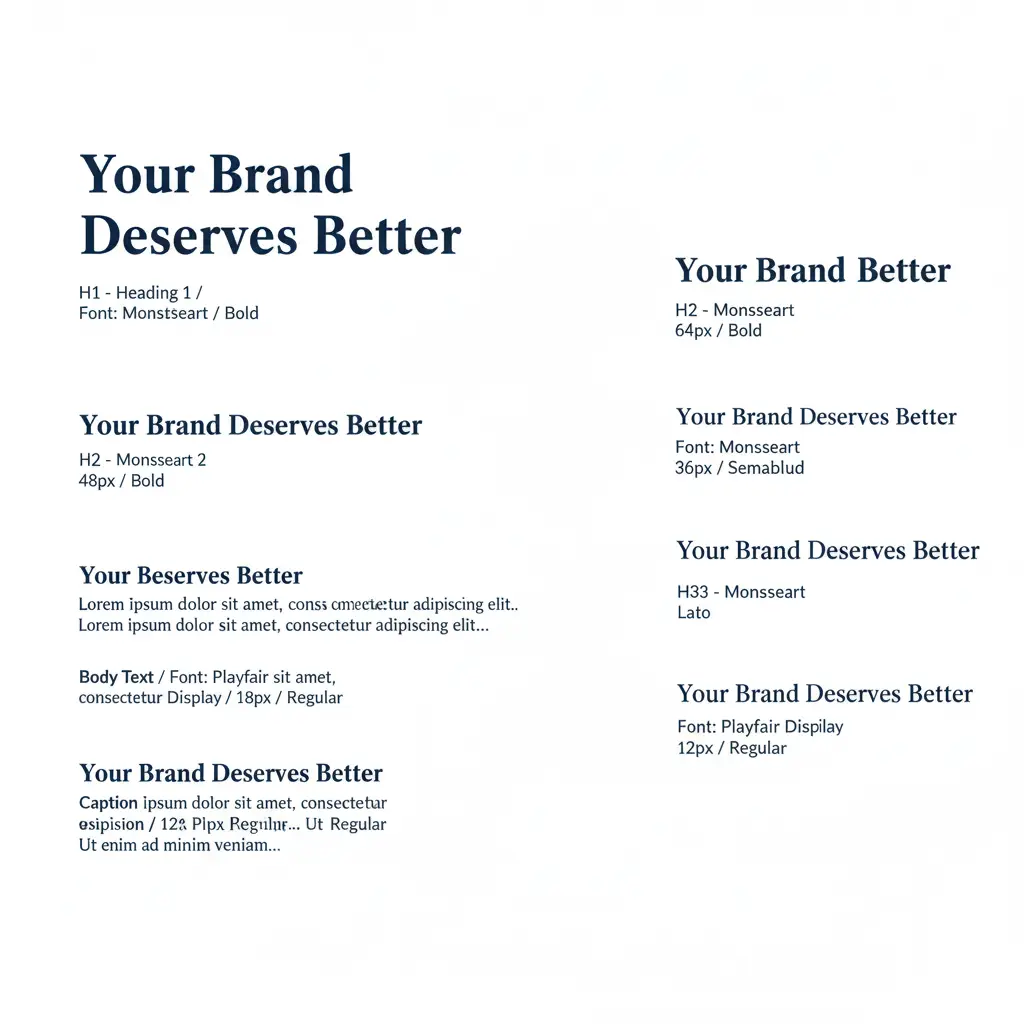
Typography communicates personality before anyone reads a single word. Your type system needs:
- Primary typeface — Usually for headlines and prominent text
- Secondary typeface — Often for body copy and longer content
- Hierarchy rules — Specific sizes, weights, and spacing for H1, H2, H3, body text, captions
The best typography systems balance distinction with readability. A luxury law firm might pair a refined serif with a clean sans-serif. A tech startup might use modern geometric fonts that feel innovative and approachable.
4. Visual Style and Imagery
This element defines the look and feel of all visual content beyond your logo:
- Photography style — Bright and airy vs. moody and dramatic? Lifestyle vs. product-focused?
- Illustration approach — Realistic, abstract, hand-drawn, or none at all?
- Graphic elements — Patterns, shapes, icons, lines that appear consistently
- Layout principles — Grid systems, spacing rules, composition guidelines
Visual style is where brands often diverge most dramatically. A children’s educational brand might use playful illustrations and bright photos of kids learning. A B2B cybersecurity company might use dark, technical imagery with data visualization elements.
5. Brand Voice and Messaging
Your visual identity needs a verbal counterpart. Brand voice defines how you communicate:
- Tone attributes — Are you professional or conversational? Bold or reassuring?
- Language guidelines — Industry jargon vs. plain language? Formal vs. casual?
- Messaging pillars — Core themes you consistently return to
- Key phrases — Distinctive ways you describe your value
A strong brand voice sounds like a specific person. When your team writes website copy, social posts, or customer emails, they should all sound like they’re coming from the same business. For more on developing messaging, check out our guide on how to write a brand brief.
6. Brand Guidelines Document
This is your brand identity bible. A comprehensive guidelines document ensures consistency across your team, freelancers, and partners.
Essential sections include:
- Brand story and values — The “why” behind your identity choices
- Logo usage rules — Dos, don’ts, minimum sizes, clear space requirements
- Color specifications — With exact codes for all applications
- Typography rules — Font files, pairing guidelines, hierarchy examples
- Visual style examples — Correct and incorrect applications
- Voice and tone guide — With writing samples and common scenarios
The most effective brand guidelines are living documents, not PDFs collecting dust. They’re accessible, searchable, and updated as your brand evolves.
7. Brand Applications (Touchpoints)
Finally, your identity needs to be applied across every customer touchpoint:
- Digital — Website, social media, email templates, digital ads
- Print — Business cards, letterhead, packaging, signage
- Marketing — Presentations, one-pagers, brochures, trade show materials
- Internal — Employee onboarding materials, internal communications
This is where brand identity proves its value. When every touchpoint reinforces the same visual and verbal identity, recognition compounds. Customers begin to spot your content in their feed before they even see your name.
Why Brand Identity Matters for Your Business
If you’re still thinking “this seems like a lot for a small business,” consider what’s actually at stake.
Builds Recognition and Trust
Harvard Business Review reports that brand trust is one of the primary factors influencing purchase decisions. But trust doesn’t happen instantly. It builds through repeated, consistent experiences.
When a potential customer sees your LinkedIn post, visits your website, receives your email, and attends your webinar, and every touchpoint feels cohesive and professional, trust accumulates. Your brand identity is the vehicle for that consistency.
Visual consistency alone makes your brand 3.5 times more likely to enjoy strong brand visibility compared to brands with inconsistent presentation, according to studies on brand recognition.
Supports Premium Pricing
Strong brand identity gives you pricing power. When customers perceive your brand as professional, established, and premium, they’re willing to pay more for the exact same product or service.
Consider two landscaping companies offering identical services. Company A has a forgettable logo, inconsistent photos on social media, and generic messaging. Company B has a cohesive brand identity: professional photography, consistent visual style, and clear messaging about their unique approach.
Company B can charge 30-40% more for the same work because their brand identity signals expertise, reliability, and premium quality before a single customer interaction happens.
Creates Consistency Across Channels
The average customer touches 7-8 different channels before making a purchase decision. They might discover you on Instagram, visit your website, read your Google reviews, check your LinkedIn, receive an email, and attend a consultation.
Without brand identity, each channel feels disconnected. With it, every touchpoint reinforces the same story. The cumulative effect is exponentially more powerful than any single perfect interaction.
Attracts Your Ideal Customers
Perhaps most importantly, strong brand identity acts as a filter. It repels poor-fit customers while magnetizing your ideal audience.
When your brand identity clearly communicates who you are, what you stand for, and who you serve, the right people self-select in. They recognize themselves in your messaging and visual style. Meanwhile, customers who wouldn’t be a good fit move on, saving everyone time.
Brand Identity Examples: What Good Looks Like
Let’s look at three realistic examples of businesses that invested in professional brand identity and saw measurable results.
Example 1 — Small Service Business: Hartwell Home Services
Business Type: Residential HVAC and plumbing company, Denver metro area
Challenge: Competing with 200+ local service providers, struggling to move beyond word-of-mouth
Brand Identity Solution: Hartwell invested in a complete brand identity system featuring a modern, trustworthy logo with a house icon, a warm color palette (navy blue, copper orange, soft gray), and professional photography of their actual technicians. They developed a friendly but professional brand voice and created templates for truck wraps, uniforms, service invoices, and social media.

Results: Within 8 months of launching their new brand identity:
- Website inquiries increased by 64%
- Average project value increased from $3,200 to $4,800 (50% higher)
- Customer referral rate improved from 12% to 31%
- They successfully raised prices by 20% without customer pushback
The owner attributed the transformation to looking “as professional as we actually are.” Previously, their inconsistent branding made them appear like a side-hustle operation despite 15 years in business.
Example 2 — E-commerce Brand: Canopy & Thread
Business Type: Sustainable home textiles, direct-to-consumer online
Challenge: Launching in an oversaturated market against established competitors with bigger budgets
Brand Identity Solution: Canopy & Thread built their entire launch strategy around a distinctive brand identity: earthy color palette, minimalist logo with a thread motif, lifestyle photography featuring real homes (not sterile staged shots), and messaging focused on “conscious comfort.” Every touchpoint from packaging to email design reinforced the same aesthetic.

Results: First 12 months post-launch:
- Achieved profitability in month 4 (unusual for e-commerce)
- 43% of customers made repeat purchases within 6 months
- Social media following grew organically to 28,000 without paid influencer campaigns
- Featured in 3 design publications specifically because of their cohesive brand aesthetic
The founder noted: “Our brand identity did as much selling as our products. People bought into the whole experience, not just the sheets.”
Example 3 — B2B Company: Meridian Analytics
Business Type: Data analytics consulting for healthcare organizations
Challenge: Perceived as too technical and impersonal, struggling to win contracts against more established firms
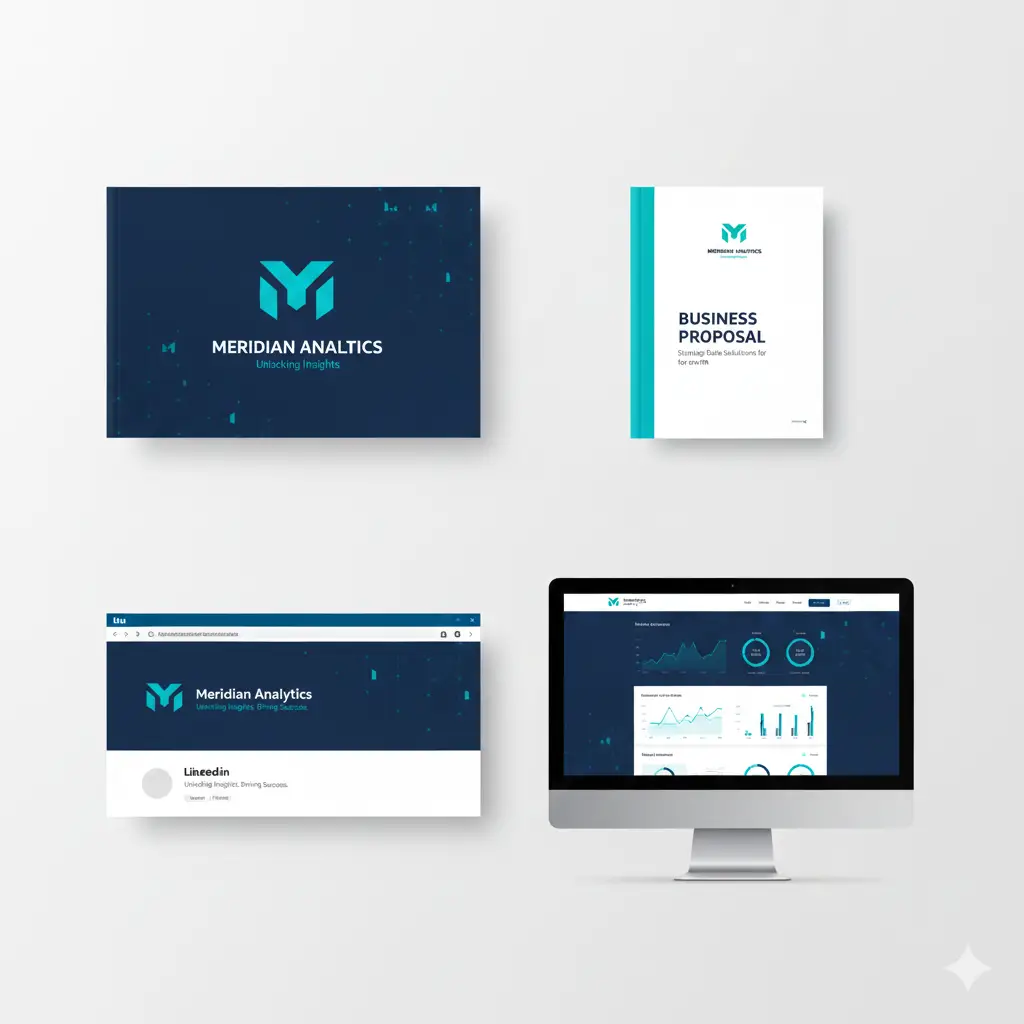
Brand Identity Solution: Meridian developed a sophisticated brand identity that balanced technical credibility with human approachability. Their identity system included a modern geometric logo, a professional color palette (deep blue, electric teal, warm gray), data visualization-inspired graphic elements, and messaging that translated complex analytics into clear business outcomes.
They applied this identity rigorously across proposals, presentations, their website, and LinkedIn presence.
Results: 18 months after brand identity implementation:
- Win rate on proposals increased from 23% to 47%
- Average contract value grew from $85,000 to $140,000
- Inbound leads increased by 190%
- Successfully recruited 5 senior consultants who cited the “professional brand presence” as a factor in joining
The CEO reflected: “We were always good at the work, but our brand made us look like a scrappy startup. The new identity helped us compete at the enterprise level.”

How to Build a Brand Identity (Overview)
Understanding what brand identity is and why it matters is step one. Actually building one requires either significant time investment or professional expertise.
DIY vs. Hiring a Professional
The DIY route can work if you have:
- Design skills and brand strategy knowledge
- 40-60 hours to invest in research, design, and iteration
- A clear understanding of your target audience and positioning
- Access to tools like Adobe Creative Suite or Canva for design work
The risks? Most business owners underestimate the strategic depth required. You might create something that looks decent but doesn’t strategically position your business or resonate with your ideal customers. Time investment is also significant—hours spent on design are hours away from revenue-generating activities.
Hiring a professional makes sense if you want:
- Strategic guidance on positioning and differentiation
- Design expertise that goes beyond aesthetics to psychology
- A complete, cohesive system delivered in weeks instead of months
- Brand guidelines and templates your team can use immediately
What to Expect from a Branding Agency
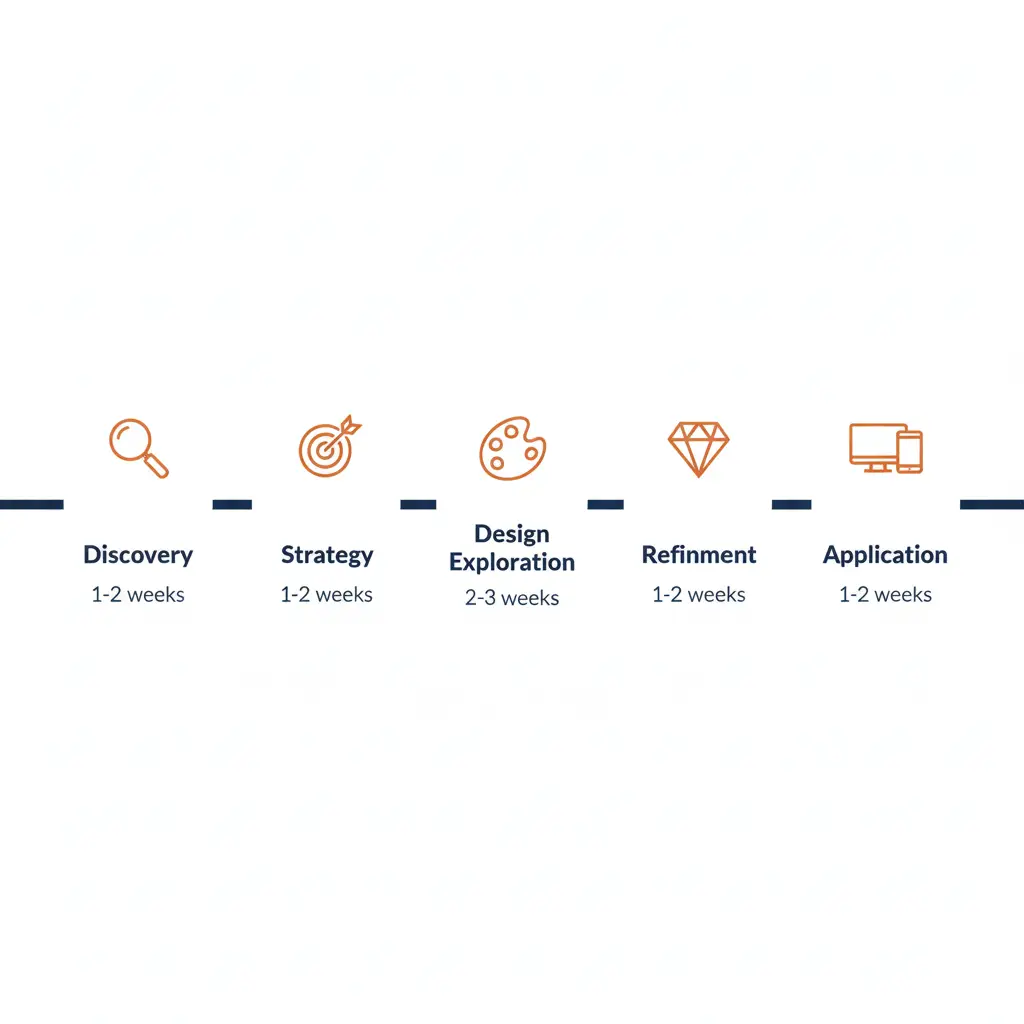
Professional brand identity services typically follow this process:
1. Discovery Phase (1-2 weeks)
Deep dive into your business, target audience, competitors, and goals. This often includes stakeholder interviews, market research, and competitive analysis. You’ll typically complete a brand brief that establishes strategic direction.
2. Strategy Development (1-2 weeks)
The agency develops your brand positioning, messaging framework, and creative direction. This strategic foundation ensures design decisions are purposeful, not just pretty.
3. Design Exploration (2-3 weeks)
Initial logo concepts and visual direction exploration. Expect to see 2-3 distinct creative directions, each with rationale for how it serves your strategy.
4. Refinement (1-2 weeks)
You select a direction, and the agency refines it into a complete system: final logo variations, color palette, typography, visual style guidelines.
5. Application & Guidelines (1-2 weeks)
The agency applies your identity across key touchpoints and creates comprehensive brand guidelines. You receive all source files, templates, and documentation.
Throughout this process, expect 3-5 presentation meetings and regular communication. Strong agencies involve you as a collaborator, not just a client receiving deliverables.
Timeline and Investment Ranges
Timeline:
Complete brand identity projects typically take 6-10 weeks from kickoff to final delivery. Rush timelines are possible but often compromise the strategic depth that makes brand identity effective.
Investment:
Pricing varies based on scope, agency experience, and your business size:
- Small business / startup: $5,000 – $15,000 for a complete brand identity system
- Established business / mid-market: $15,000 – $40,000 for comprehensive rebrand
- Enterprise / complex organizations: $40,000 – $150,000+ for multi-brand systems
This might seem like a significant investment, but consider the ROI. As the Hartwell Home Services example showed, a $12,000 brand identity investment led to a 50% increase in average project value. That pays for itself after just 8 projects.
Quality brand identity is one of the few business investments that appreciates over time. Your logo from 2025 should still be working hard for you in 2035.
Next Steps — Start Building Your Brand Identity Today
Your brand identity isn’t a nice-to-have luxury for “someday when the business is bigger.” In 2025’s hyper-competitive, digital-first marketplace, it’s the foundation that everything else builds on.
Every day without a cohesive brand identity is a day you’re:
- Losing customers to competitors with stronger visual presence
- Leaving money on the table by appearing less premium than you are
- Wasting marketing budget because your messaging doesn’t compound across channels
- Making your team’s job harder with inconsistent assets and unclear direction
Free Resources
To help you get started, we’ve created several free resources:
Brand Identity Checklist: Download our comprehensive checklist covering all 7 core elements. Use it to audit your current brand or plan your new one.
Color Psychology Guide: Learn which colors work best for different industries and emotional positioning.
Typography Pairing Examples: See 20+ professional font combinations you can use immediately.
Browse our portfolio to see examples of complete brand identity systems we’ve created for businesses across industries.
When to Contact a Branding Studio
You’re ready to work with a professional branding studio if:
✓ You’re launching a new business or product and want to start with a strong foundation
✓ Your current brand identity feels dated, inconsistent, or misaligned with where your business is heading
✓ You’re preparing for growth—raising capital, expanding to new markets, or building a team
✓ You’re losing deals or customers to competitors who simply “look more professional”
✓ You’ve tried DIY approaches and aren’t getting the results you need
Get a Free Brand Identity Audit
We’ll review your current brand presence across 3-5 key touchpoints and provide a personalized assessment with specific recommendations. No obligation, no pressure—just honest, strategic feedback on where your brand identity stands and what opportunities you might be missing.
The audit includes:
- Visual consistency analysis across your website, social media, and materials
- Competitive positioning assessment
- Specific recommendations for quick wins
- Estimated ROI projection for professional brand identity investment
Schedule Your Free Brand Identity Audit →
Your business deserves a brand identity that works as hard as you do. Let’s build one together.


